
From Dr. Sue’s Desk
Have We Misunderstood What a Prompt Really Is?
By Ts. Dr. Suhailah Mohamed Noor
Published: 5 July 2026
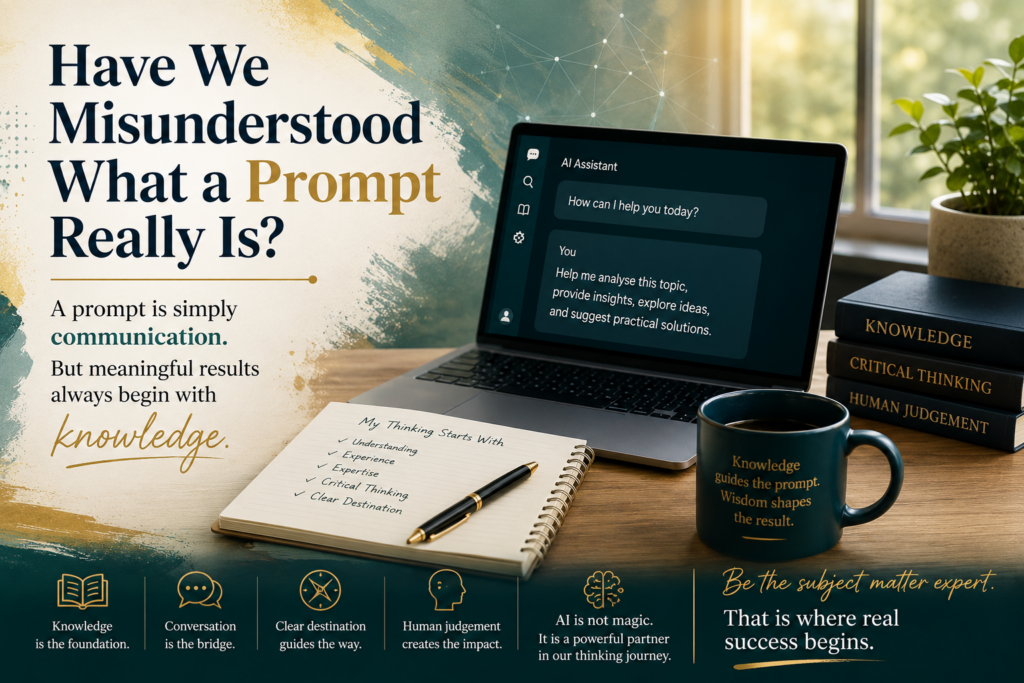
The word prompt has become one of the most frequently used words in the AI era.
It appears in social media posts, workshops, online courses and countless videos promising better results with AI.
Some discussions naturally focus on finding “better prompts”, while others share collections of prompts that promise faster or higher-quality responses.
There is certainly value in learning how to communicate effectively with AI.
Yet I often find myself reflecting on a different question.
Have we slowly started to misunderstand what a prompt really is?
Perhaps a prompt has never been a special sentence or a secret formula.
Perhaps a prompt is simply communication.
Every time we ask AI a question, we are writing a prompt.
Every time we explain an idea, describe a problem, challenge an assumption or continue a conversation, we are prompting.
Some prompts are only five words long.
Others may span several paragraphs.
Some follow structured frameworks.
Others are nothing more than a natural conversation.
They are all prompts.
The difference is not whether something is or is not a prompt.
The difference lies in the quality of the thinking behind it.
This small distinction changes everything.
When we believe success comes from finding the perfect prompt, we naturally spend our time searching for templates.
When we realise that prompting is simply communicating our thinking, we begin investing in something far more valuable.
Knowledge.
This philosophy has quietly shaped every AI book I have written.
They were never intended to become collections of ready-made prompts.
Instead, they were written to help readers develop better judgement, stronger critical thinking, ethical awareness and a deeper understanding of how AI should be used responsibly.
Prompting techniques certainly matter.
They help us organise ideas more clearly.
They help AI understand our intentions more accurately.
They improve communication.
But techniques alone cannot replace understanding.
A beautifully written prompt cannot compensate for weak subject knowledge.
AI may generate fluent answers.
Only human expertise can determine whether those answers are meaningful, accurate and useful.
That is why I often say that knowledge about AI tools is important.
Knowledge about your own discipline is even more important.
The best conversations with AI happen when both come together.
This is also why I encourage learners to become subject matter experts rather than prompt collectors.
A library filled with thousands of prompts will never replace genuine understanding.
Knowledge allows us to ask better questions.
Knowledge allows us to recognise better answers.
Knowledge allows us to challenge AI instead of simply accepting whatever it produces.
Perhaps that is the real purpose of prompting.
Not to control AI.
But to communicate our thinking more clearly.
AI does not replace human intelligence.
It responds to it.
The future of AI may not belong to those who possess the largest collection of prompts.
It may belong to those who continue learning, continue thinking and continue developing wisdom in their own fields.
Because in the end, prompting is only one part of the conversation.
Knowledge is what gives that conversation meaning.
Knowledge comes before prompting.
About the Author
Ts. Dr. Suhailah Mohamed Noor is the Founder of Prompt Academy, an AI educator, author and researcher who believes that technology should strengthen human thinking rather than replace it.
Through her books, workshops and writing, she advocates responsible AI adoption grounded in knowledge, critical thinking and human judgement.
“Knowledge comes before prompting.”