
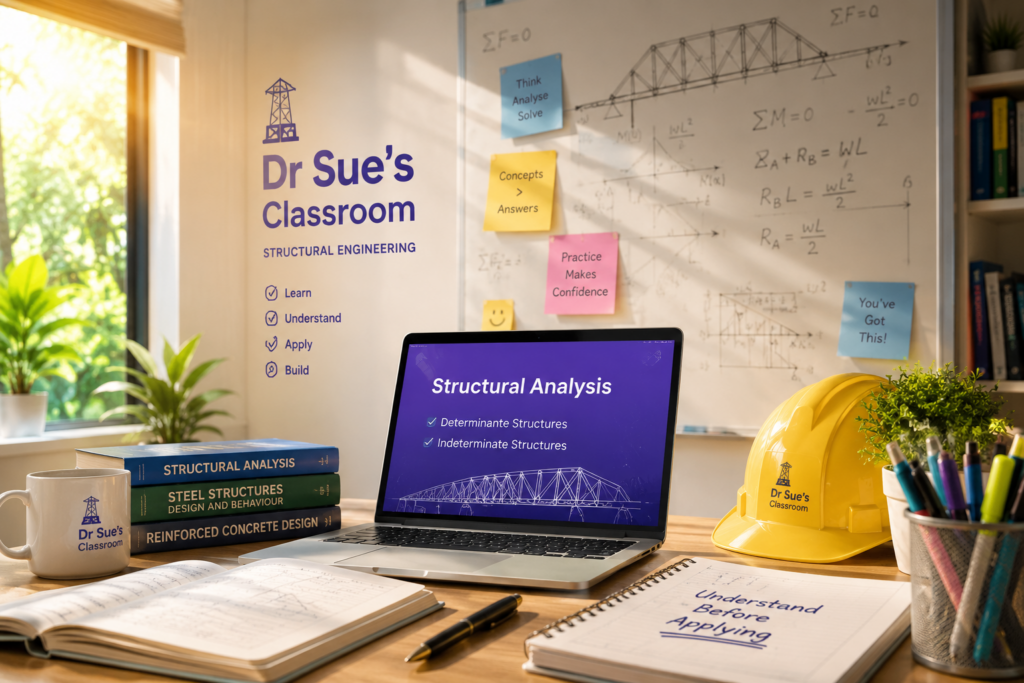
Dr Sue’s
Classroom
A dedicated digital classroom for students enrolled in Dr Sue’s Structural Engineering courses. Learn through structured resources guided examples and purposeful practice.
Explore the Classroom ↓Build understanding before solving
Dr Sue’s Classroom is a private learning space created to complement classroom teaching and support independent revision.
The resources are organised to help students understand the behaviour of structures before applying analytical methods.
This classroom is not intended to replace lectures. It is designed to strengthen the learning journey through clear pathways guided examples and selected learning activities.
Learning beyond the lecture room
Each section is developed to help students connect theory analytical procedures and engineering judgement.
Choose your learning pathway
The Structural Analysis learning journey begins with the fundamental behaviour of determinate structures before progressing towards indeterminate structures.
Determinate Structures
Review the fundamental principles required to understand structural behaviour equilibrium and internal force actions.
Indeterminate Structures
Explore structural systems that require equilibrium compatibility and force-displacement relationships for complete analysis.
Three analytical methods
The analysis of statically indeterminate structures can be approached through different methods.
Each method offers a different way of viewing force displacement stiffness and compatibility.
Students are encouraged to understand the logic behind each method rather than memorising calculation procedures.
Flexibility Method
Analyse redundant forces through compatibility deformation and flexibility relationships.
Stiffness Method
Study structural response through joint displacement member stiffness and equilibrium relationships.
Moment Distribution Method
Understand how unbalanced moments are distributed and carried through continuous structural systems.
Support for every stage of learning
Classroom materials are organised to support understanding practice reflection and preparation for assessment.
Learning Notes
Structured explanations that complement lectures and support personal revision.
Guided Examples
Worked examples designed to show the thinking process behind each analytical step.
Practice Activities
Selected exercises that help students strengthen analytical accuracy and confidence.
Reflection
Opportunities to evaluate understanding identify difficulties and improve learning strategies.
AI can support the process.
Understanding must remain human.
Selected activities may invite students to use AI as a learning companion. Students are expected to question AI responses verify analytical steps and maintain responsibility for every decision and final answer.
Access to Dr Sue’s Classroom
This learning portal is available only to students enrolled in Dr Sue’s classes for the relevant academic semester. Access details and the classroom password will be provided directly by Dr Sue.