
Research & Academic Writing
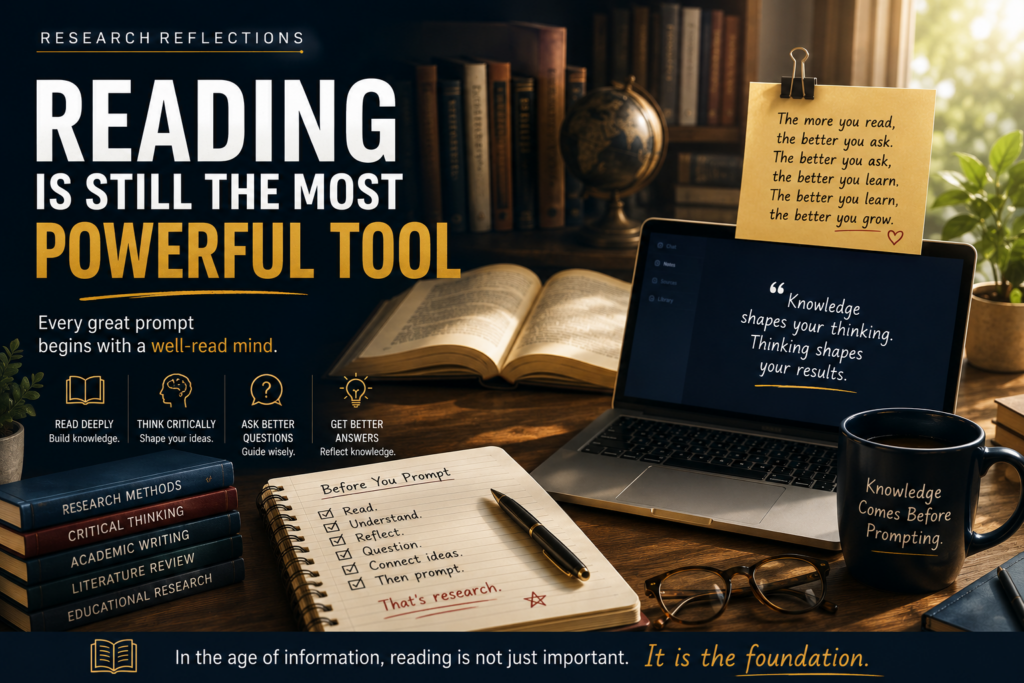
Reading Is Still the Most Powerful Tool Every Great Prompt Begins With a Well-Read Mind.
In the age of AI, reading is not outdated. It is the foundation that shapes knowledge, questions, thinking and better conversations with AI.
Reflection by: Ts. Dr Suhailah Mohamed Noor
Date written: 7 July 2026
Published: 7 July 2026
Reading time: 7 min read
Category: Research & Academic Writing
Author’s note
This article reflects the author’s original ideas, professional experience and human judgement. AI was used as a writing partner to help organise and communicate the author’s ideas under the author’s direction and judgement.
Everyone is searching for a better AI tool.
A better model.
A better prompt.
A better workflow.
But perhaps one of the most powerful tools has been with us all along.
Reading.
Of course, reading is not literally an AI tool.
ChatGPT is an AI tool.
Gemini is an AI tool.
Claude is an AI tool.
NotebookLM is an AI tool.
So why call reading the most powerful tool in the age of AI?
Because every meaningful conversation with AI depends on something AI cannot create for us.
Knowledge.
And for researchers, educators, students and lifelong learners, knowledge often begins with reading.
The quality of your prompt depends on the quality of your thinking
Many people ask how to write better prompts.
It is a good question.
But perhaps there is a question that should come before it.
How do we build better thinking?
A prompt is not only a sentence typed into AI.
A prompt carries our intention, our knowledge, our vocabulary, our assumptions, our curiosity and our ability to ask meaningful questions.
That is why two people can use the same AI tool and receive very different results.
The model may be the same.
The subscription may be the same.
Even the prompt may look similar.
But the mind behind the prompt is different.
Reading changes the mind behind the prompt.
- It builds vocabulary.
- It expands context.
- It sharpens judgement.
- It improves questioning.
- It helps us recognise better answers.
A well-read mind asks better questions
AI responds to what we ask.
But the quality of what we ask depends on what we already understand.
When we read more, we do not only collect information.
We learn how ideas are built.
We learn how arguments are formed.
We learn how evidence is used.
We learn how scholars disagree, refine and extend knowledge.
By the time we open ChatGPT, we are no longer asking random questions.
We are asking informed questions.
Better reading leads to better thinking.
Better thinking leads to better prompts.
The prompt is only the visible part
People often ask for prompts.
They want to know what sentence was used.
They want the final wording.
They want the shortcut.
But a great prompt is rarely created in one attempt.
Behind a useful prompt, there is usually a long process that people do not see.
The reading.
The thinking.
The questioning.
The trial and error.
The conversations.
The knowledge gathered over time.
The final prompt may look simple.
But what gives it power is everything that happened before it was written.
The value is not only in the prompt. The value is in the mind that created the prompt.
Reading makes AI more meaningful
AI can generate answers quickly.
But speed is not the same as meaning.
AI can produce paragraphs.
But paragraphs are not always knowledge.
AI can suggest ideas.
But not every suggestion is suitable, accurate or useful.
Reading helps us recognise the difference.
It helps us know when AI is being too general.
It helps us notice when AI is missing context.
It helps us question an answer that sounds confident but feels shallow.
It helps us refine the response because we understand the subject matter more deeply.
AI reflects the quality of the conversation we bring to it.
And the quality of that conversation depends on the knowledge we carry.
Knowledge comes before prompting
At Prompt Academy, this is the belief that holds everything together:
Knowledge Comes Before Prompting.
This is not just a tagline.
It is a reminder that AI should not become the beginning of our thinking.
Before prompting, there must be reading.
Before prompting, there must be learning.
Before prompting, there must be curiosity.
Before prompting, there must be understanding.
AI can help us organise what we know.
It can help us express what we think.
It can help us refine what we are trying to say.
But if there is nothing meaningful behind the prompt, AI may only produce something that sounds polished but feels empty.
The real advantage is not the tool
In the age of AI, it is easy to believe that the person with the latest tool has the greatest advantage.
But the real advantage may belong to the person who reads deeply.
The person who understands the field.
The person who can ask better questions.
The person who can compare ideas.
The person who can recognise weak reasoning.
The person who can guide AI instead of simply receiving whatever AI gives.
That is why reading still matters.
Not because it belongs to the past.
But because it prepares us for the future.
Every great prompt begins with a well-read mind.
Closing reflection
People often ask about the best AI tools.
The truth is, tools will keep changing.
Models will keep improving.
Platforms will keep evolving.
But the need for knowledge will not disappear.
The need for reading will not disappear.
The need for thinking will not disappear.
Because every time we read, we build something AI cannot build for us.
We build our mind.
And every time our mind grows, the way we use AI changes.
We ask better.
We judge better.
We refine better.
We create better.
Reading is still the most powerful tool.
Not because it replaces AI.
But because it makes every conversation with AI more meaningful.
About the Author
Ts. Dr Suhailah Mohamed Noor is the Founder of Prompt Academy and a Senior Lecturer in Civil Engineering. Her work focuses on AI literacy, responsible AI adoption, prompting skills, critical thinking and knowledge-driven use of artificial intelligence in education and research.
Knowledge Comes Before Prompting.