
It Sounds Like Me
Because It Is Me
Written by Ts. Dr. Suhailah Mohamed Noor • Published on 13 June 2025 • Reading Time: 5 minutes
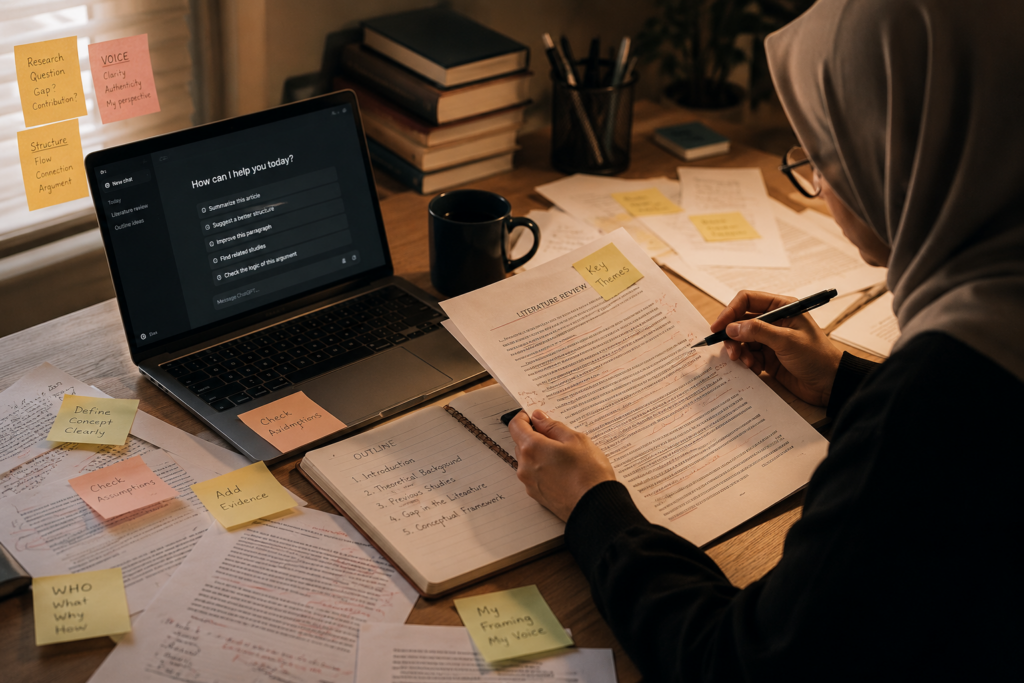
AI can assist the writing process. But the voice, judgement and ownership must remain human.
The Common Fear:
“If I Use AI, Is It Still My Work?”
Let’s be honest. As educators and researchers, we’ve been told to fear AI in writing.
There’s this growing anxiety. If AI helps structure a paragraph, rephrase a sentence or suggest a citation, is the final work still “mine”?
Or worse, will it be flagged as “AI-generated”?
Authorship is not about who typed the words.
It is about who shaped the thinking.
But here’s what I’ve learned: authorship is not about who typed the words.
It’s about who structured the ideas, made the decisions and shaped the thinking behind the words.
I recently asked ChatGPT to help me write a section of my literature review.
When I read the output, it sounded polished.
It sounded clear.
And strangely, it sounded like me.
But was it really mine? Was it now “100% AI-generated”?
That question made me pause. And reflect.
“Prompt Mode wasn’t born in theory.”
“It was born in the classroom.”
Dr Suhailah, AI Premium Workshop, 12 June 2025
The idea for Prompt Mode actually emerged during a hands-on session in my AI Premium Workshop on 12 June 2025, where we explored how to use ChatGPT to structure literature reviews in real time.
I was guiding participants on synthesis techniques when I realised: students don’t just need prompts. They need Prompt Mode, a mindset, not a command.
Here’s what didn’t happen
✕ I didn’t ask AI to “write me a lit review.”
✕ I didn’t copy-paste blindly.
Here’s what actually happened
✓ I shortlisted 7 to 8 scholarly articles manually.
✓ I structured the outline with my own logic and flow.
✓ I knew the voice I wanted.
✓ I prompted, refined and rewrote.
And most importantly: I rejected, tweaked and challenged the output until it sounded like me.
Because it was me.
Technically?
Yes.
The AI helped generate a draft.
Ethically, cognitively and pedagogically?
No.
Because I led the process. I chose what stayed.
I brought the nuance, the experience and the human voice to the page.
This is what I call AI-aware writing, not passive use but thoughtful authorship.
Final Thought: It’s Not About Hiding AI
It’s about owning the process.
If you’re an educator, a student or a researcher wondering whether it’s “okay” to use AI, ask yourself this:
Did I think deeply before, during and after the AI’s help?
If yes, then AI is not replacing your thinking.
It’s enhancing it.
No AI can sound like you…
unless you told it how to.
Share this reflection
About the Author
Ts. Dr. Suhailah Mohamed Noor is the Founder of Prompt Academy, an AI educator, author and researcher who advocates responsible and knowledge-driven use of artificial intelligence. Through her writing, training and research, she believes that AI should strengthen human thinking, not replace it.