
Research
Changing the Words Doesn’t Change the Thinking Perhaps We Have Been Solving the Wrong Problem.
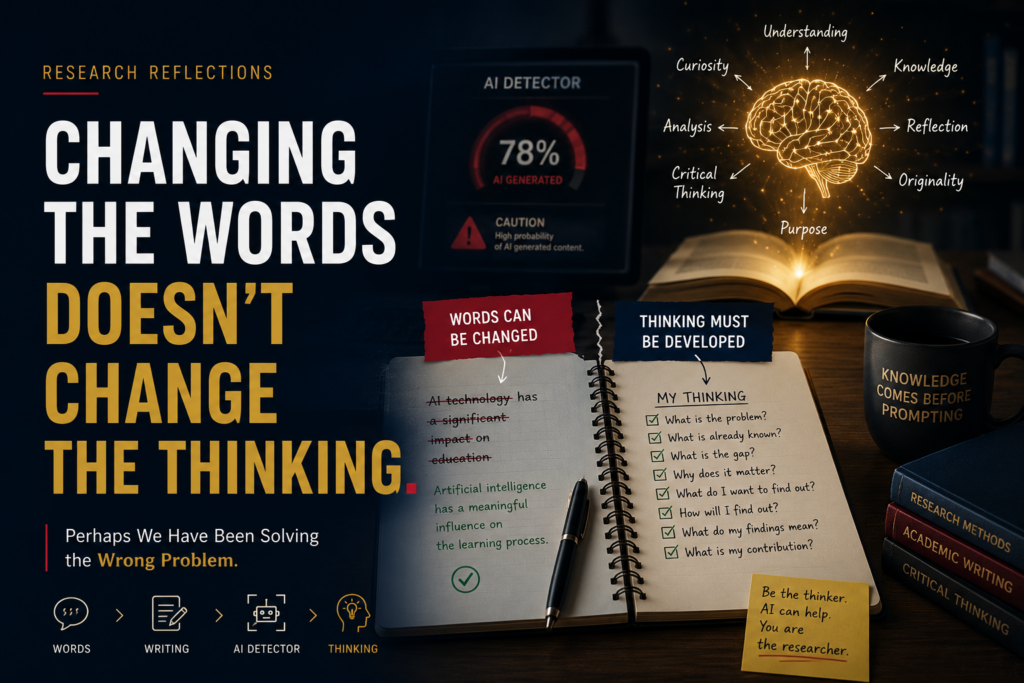
Paraphrasing may change how a sentence looks. But it does not automatically create understanding, originality or real academic thinking.
Reflection by: Ts. Dr Suhailah Mohamed Noor
Date written: 7 July 2026
Published: 7 July 2026
Reading time: 7 min read
Category: Research & Academic Writing
Author’s note
This article reflects the author’s original ideas, professional experience and human judgement. AI was used as a writing partner to help organise and communicate the author’s ideas under the author’s direction and judgement.
These days, many people worry about AI detectors.
They worry that their writing may be flagged.
So they look for another solution.
Paraphrase it.
Change the words.
Make it sound more human.
At first, it sounds reasonable.
If the words are changed, maybe the detector will be less suspicious.
If the sentence structure is different, maybe the writing will look more original.
If the paragraph sounds more natural, maybe the problem is solved.
But is it really solved?
Or have we only changed the surface?
Changing the words does not change the thinking.
Perhaps the problem was never the wording
A sentence can be rewritten many times.
It can be made shorter.
It can be made longer.
It can be made more academic.
It can be made more conversational.
But if the person behind the sentence does not understand the idea, the problem remains.
If the argument is weak, paraphrasing will not make it strong.
If the research gap is unclear, changing the words will not suddenly create clarity.
If the methodology does not match the research question, polished language will not fix the design.
If the discussion does not interpret the findings, nicer wording will not create deeper analysis.
This is why AI detectors should not make us focus only on wording.
They should make us ask a deeper question.
The real question is not only:
How do I make this text pass a detector?
The real question should be:
Do I understand what this text is actually saying?
A detector may flag words. A supervisor sees thinking.
AI detectors look at patterns.
They analyse probability.
They estimate whether a text looks like it may have been generated by AI.
But academic work is not judged only by patterns.
A supervisor does not only read the sentence.
A reviewer does not only look at the wording.
An examiner does not only ask whether the paragraph sounds human.
They look for understanding.
They look for logic.
They look for coherence.
They look for originality.
They look for the ability to explain, defend and connect ideas.
A paragraph may pass an AI detector and still fail as academic writing.
Why?
Because academic writing is not just about appearing human.
It is about showing human thinking.
A detector may analyse words.
But scholarship is built through thinking.
Paraphrasing is not wrong. Depending on it blindly is the problem.
This does not mean paraphrasing is always wrong.
Paraphrasing is an important academic skill.
A good researcher must know how to read, understand and express an idea using their own words.
But real paraphrasing is not simply replacing words.
It is not just changing sentence structure.
It is not merely making AI-generated text look different.
True paraphrasing begins with understanding.
You read.
You pause.
You ask what the author really means.
You connect the idea to your own argument.
Then you write it again in a way that serves your purpose.
That process requires thinking.
Without thinking, paraphrasing becomes decoration.
The words change.
The understanding does not.
Real paraphrasing is not about hiding the source of the sentence. It is about showing that you understand the idea.
AI can help you rewrite. But can you explain it?
AI can rewrite a sentence very quickly.
It can make the tone more academic.
It can simplify a paragraph.
It can organise scattered ideas into a clearer structure.
These are useful supports.
But after AI helps rewrite the sentence, one question remains.
Can you explain what the sentence means without reading it?
If the answer is yes, AI has assisted your thinking.
If the answer is no, AI may have replaced your thinking.
That is where the real risk begins.
The risk is not only that a detector may flag the text.
The bigger risk is that the writer may no longer own the idea.
In research, ownership of thinking matters.
A postgraduate student must be able to defend the thesis.
A final year project student must be able to explain the work.
A researcher must be able to justify the argument.
If we cannot explain what we have written, the problem is deeper than AI detection.
The problem is understanding.
The danger of polished emptiness
One of the biggest challenges with AI writing is that it can sound confident even when the thinking is weak.
It can produce paragraphs that look smooth.
It can use academic phrases.
It can connect ideas in a way that sounds convincing.
But polished writing is not always meaningful writing.
Sometimes, the paragraph sounds good because the language is good.
But when we read more carefully, the argument may still be vague.
The contribution may still be unclear.
The connection to literature may still be weak.
The interpretation may still be shallow.
This is what I call polished emptiness.
It looks complete.
It sounds academic.
But it does not carry enough thinking.
Beautiful wording cannot replace weak understanding.
So what should we focus on?
Instead of asking how to make writing pass AI detectors, perhaps we should ask better questions.
Do I understand the concept?
Do I know why this literature matters?
Do I know the gap I am addressing?
Do I know why this method is appropriate?
Do I know what my findings mean?
Do I know how my work contributes to the field?
Can I explain my argument in my own words?
If these questions can be answered, AI becomes a useful assistant.
It can help organise the writing.
It can help improve clarity.
It can help refine expression.
But the thinking still belongs to the researcher.
Before rewriting, ask:
- What am I really trying to say?
- Why does this idea matter?
- How does it connect to my research question?
- What evidence supports this point?
- Can I explain this without looking at the paragraph?
AI should support thinking, not hide the absence of it
AI can be a powerful academic support tool when used responsibly.
It can help researchers communicate more clearly.
It can help students see the structure of an argument.
It can help writers improve flow.
It can help make complex ideas easier to express.
But AI should not be used to hide the absence of understanding.
It should not be used to cover weak thinking with strong language.
It should not be used to make a paragraph look academic when the idea behind it is not yet clear.
That is why the answer is not simply more paraphrasing.
The answer is more thinking.
Changing the words may satisfy a detector.
Only strengthening the thinking improves the researcher.
Closing reflection
Perhaps the issue with AI-generated writing is not only whether it can be detected.
Perhaps the deeper issue is whether the writer still owns the thinking.
If the writer understands the idea, AI can help refine the expression.
If the writer has a clear argument, AI can help organise the flow.
If the writer knows the field, AI can help communicate the knowledge more effectively.
But if the thinking is missing, changing the words will not create it.
In the end, paraphrasing is not the answer if understanding was never there.
The real answer begins before the sentence is rewritten.
It begins with reading.
It begins with questioning.
It begins with understanding.
It begins with thinking.
Changing the words does not change the thinking.
Real academic writing begins when the writer understands what the words are trying to say.
Knowledge Comes Before Prompting.
About the Author
Ts. Dr Suhailah Mohamed Noor is the Founder of Prompt Academy and a Senior Lecturer in Civil Engineering. Her work focuses on AI literacy, responsible AI adoption, prompting skills, critical thinking and knowledge-driven use of artificial intelligence in education and research.
Knowledge Comes Before Prompting.