
Research & Academic Writing
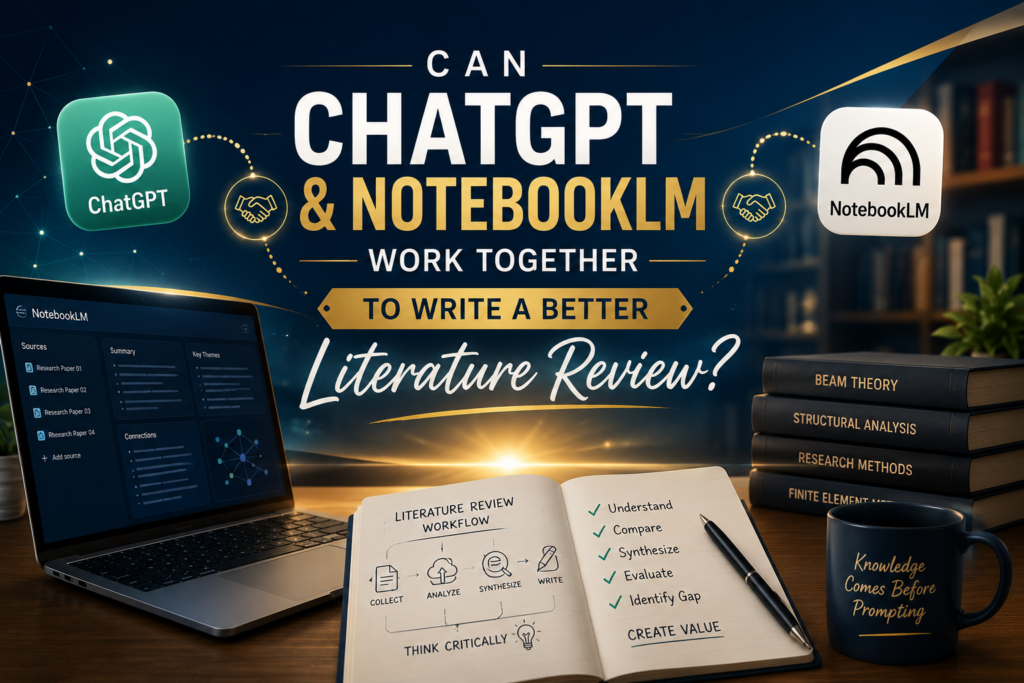
Can ChatGPT and NotebookLM Work Together to Write a Better Literature Review?
Two AI tools can support one powerful research workflow. The real question is not whether they can write for us. The real question is whether we know how to use them to read better, think deeper and write with greater academic responsibility.
From Dr Sue’s Desk
“NotebookLM can keep us close to the evidence. ChatGPT can help us shape the thinking. Yet the quality of a Literature Review still depends on the knowledge, judgement and intellectual honesty of the researcher.”
Many students and researchers ask the same question:
“Can I write my Literature Review using only ChatGPT and NotebookLM?”
My honest answer is yes. It is possible to use these two tools as the main AI support system for developing a Literature Review.
However the answer comes with an important condition. ChatGPT and NotebookLM may support the process. They must not replace the articles, the subject knowledge or the judgement of the researcher.
Two AI Tools. Two Different Roles.
ChatGPT and NotebookLM are sometimes treated as if they perform the same function. They do not.
NotebookLM is strongest when the researcher already has a collection of relevant sources. ChatGPT becomes most useful after the evidence has been understood, organised and placed within a clear research direction.
When these tools are used together each tool strengthens a different part of the academic process.
NotebookLM Grounds the Evidence
NotebookLM works from the documents supplied by the researcher. It helps the user remain connected to the selected journal articles rather than relying on broad or unverified online information.
It is particularly useful for extracting findings, tracing evidence, comparing studies and identifying recurring themes across multiple papers.
ChatGPT Shapes the Thinking
ChatGPT is useful for organising ideas, improving logical flow, developing synthesis and strengthening the clarity of academic writing.
Its value becomes greater when the researcher already understands the evidence and knows the direction of the argument.
NotebookLM Is Not a Replacement for Reading
One of the biggest misunderstandings about NotebookLM is the belief that uploading several papers means the researcher no longer needs to read them.
NotebookLM can shorten the time required to locate important information. It can show relationships between sources and identify where specific statements originated. It can also help the researcher compare methodologies, results and limitations.
Yet it cannot decide which findings are academically stronger. It cannot fully judge whether a methodology is appropriate for the researcher’s field. It cannot determine whether a research gap is meaningful or merely convenient.
NotebookLM helps researchers read more efficiently. It does not remove the need to read critically.
ChatGPT Should Not Be Asked to Invent the Literature
A common mistake is to begin by asking ChatGPT to write a Literature Review before the researcher has collected and understood the relevant literature.
The resulting text may appear polished. It may include convincing academic phrases and a smooth structure. However the discussion can still be generic, repetitive or disconnected from the actual evidence.
In some cases researchers then search for papers that appear to support text that has already been generated. This reverses the proper academic process.
The literature should shape the argument. The argument should not be written first and supported later with convenient references.
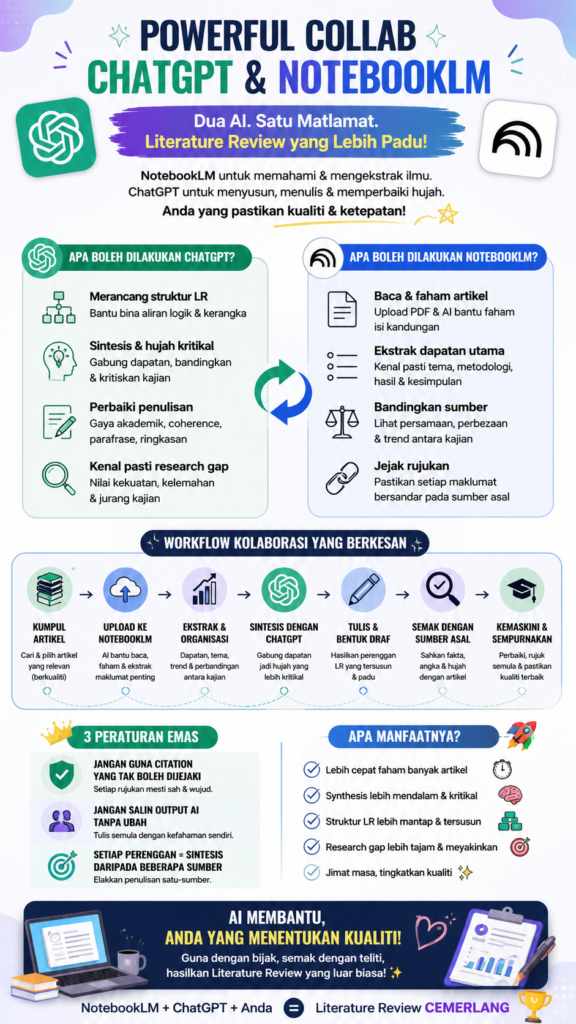
A Better Workflow for Literature Review Writing
The strongest workflow begins with knowledge and evidence rather than with prompting.
Collect relevant and credible articles
Select sources based on the research question, field, publication quality and relevance to the study.
Upload the selected sources to NotebookLM
Use the tool to identify key findings, themes, methods, similarities, differences and limitations.
Organise the evidence into themes
Group the literature according to concepts, methods, findings, debates or gaps rather than summarising one article at a time.
Use ChatGPT to strengthen synthesis
Ask for help to compare evidence, improve coherence, develop transitions and clarify the logical relationship between studies.
Verify every important statement
Return to the original article before finalising any fact, interpretation, number, quotation or citation.
Write in your own academic voice
The final text should reflect the researcher’s understanding, judgement and interpretation of the literature.
A Literature Review Is More Than a Collection of Summaries
A weak Literature Review often follows a predictable pattern. One study is described. Another study is described. A third study is added. The chapter becomes a long list of researchers and findings.
A strong Literature Review does something different. It connects studies. It shows where researchers agree, where they disagree and why the differences matter.
It also evaluates the limitations of existing knowledge and explains how the current research responds to an unresolved issue.
Descriptive review
Reports what each article says without establishing meaningful relationships between the studies.
Critical synthesis
Compares evidence, evaluates differences and builds a coherent argument that leads towards the research gap.
Three Rules That Should Never Be Compromised
Rule 1: Never use a citation that cannot be traced
Every citation must correspond to a real source and the source must genuinely support the statement being made.
Rule 2: Never copy AI output directly
AI-generated text must be reviewed, verified and rewritten so that it reflects the researcher’s real understanding.
Rule 3: Never confuse fluency with accuracy
A confident and polished paragraph is not automatically correct. Academic quality depends on evidence rather than on impressive wording.
My Honest View
I do not see ChatGPT and NotebookLM as competing tools.
NotebookLM helps the researcher remain close to the selected literature. ChatGPT helps the researcher turn organised evidence into a clearer and more coherent academic discussion.
Together they can reduce the time required to process many articles. They can improve organisation and support a more systematic writing process.
Yet the most important part of the collaboration is still human. The researcher decides which articles matter, which evidence is strong, which gap is meaningful and which conclusion is academically defensible.
The Collaboration That Matters
NotebookLM grounds the evidence.
ChatGPT shapes the thinking.
The researcher determines the quality.
Knowledge Must Still Come First
The ability to access AI tools does not automatically produce a strong Literature Review.
Researchers still need sufficient subject knowledge to recognise an important concept, question a weak claim and evaluate whether the evidence truly supports the argument.
This is why knowledge remains the foundation of meaningful interaction with AI.
AI may help us read faster and write better. Knowledge helps us decide what is worth reading, what is worth writing and what is worth believing.
Idea and reflection by
Ts. Dr. Suhailah Mohamed Noor
Founder of Prompt Academy. Educator, researcher and AI trainer advocating responsible AI use grounded in knowledge, critical thinking and human judgement.
Share this reflection
Prompt Academy
Knowledge Comes Before Prompting