
Research
Can AI Write Your Research Paper? Perhaps We Are Asking the Wrong Question.
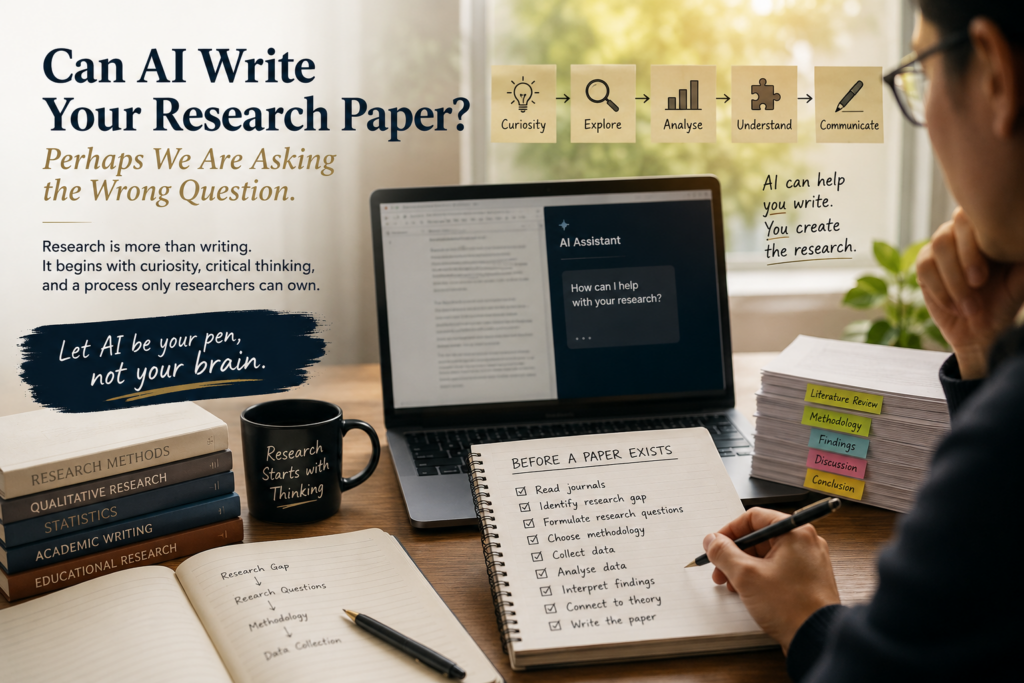
Research is more than writing. It begins with curiosity, knowledge, critical thinking and a process only researchers can own.
Reflection by: Ts. Dr Suhailah Mohamed Noor
Date written: 6 July 2026
Published: 6 July 2026
Reading time: 7 min read
Category: Research & Academic Writing
Author’s note
This article reflects the author’s original ideas, professional experience and human judgement. AI was used as a writing partner to help organise and communicate the author’s ideas under the author’s direction and judgement.
Everyone wants to know whether AI can write a research paper.
Almost nobody asks how a research paper is actually created.
Can AI write your research paper?
Perhaps we are asking the wrong question.
Every now and then, someone asks whether AI can help them complete a research paper, a final year project, a thesis or even a PhD chapter.
It is an understandable question. AI can write quickly. AI can produce polished sentences. AI can summarise, paraphrase, organise ideas and improve language.
But perhaps the question is not whether AI can write.
Perhaps the real question is this:
What actually makes a research paper a research paper?
Is it the writing?
Or is it everything that happens before the writing begins?
Before a paper exists
Before the first paragraph is written, a researcher has usually gone through a long process of thinking.
Someone has read journal articles.
Someone has tried to understand what is already known.
Someone has noticed what is still missing.
Someone has identified a research gap.
Someone has formulated research questions.
Someone has chosen a methodology.
Someone has collected data.
Someone has analysed the findings.
Someone has interpreted the results.
Someone has connected the findings back to theory, literature and practice.
Only after all these intellectual processes does the writing begin to take shape.
Before a paper is written, research has already happened:
- Reading the literature.
- Understanding the field.
- Identifying the research gap.
- Formulating research questions.
- Choosing the methodology.
- Collecting data.
- Analysing the findings.
- Interpreting the results.
- Connecting the work to theory.
- Building the contribution.
So when people say AI wrote the paper, we may need to pause for a moment.
Did AI really create the research?
Or did AI help express a research process that already belonged to the researcher?
Writing is not the whole research
A research paper is not judged only by how beautiful the sentences sound.
A paper may be written in excellent English and still be rejected.
Why?
Because academic writing is not simply about language.
It is about logic, argument, evidence, originality, methodology, interpretation and contribution.
AI may help polish the language. It may help make a paragraph clearer. It may suggest a better structure. It may help the researcher communicate more effectively.
But AI does not automatically know whether the research gap is meaningful.
AI does not know whether the methodology is truly appropriate for the problem.
AI does not own the data.
AI does not carry the responsibility of interpretation.
AI does not stand in the viva.
The researcher does.
People think AI writes research papers.
In reality, researchers create research papers.
Two people can use the same AI and get very different outcomes
Imagine two people using the same AI tool.
One is just starting to understand what research means.
The other has spent years reading, questioning, analysing and working deeply within a field.
They both ask AI to help with a research paper.
Will they get the same quality of output?
Probably not.
The tool may be the same, but the thinking behind the tool is not.
The difference is not only in the prompt.
The difference is in the knowledge of the person using the prompt.
This is why subject matter knowledge matters so much.
A researcher who understands the field can question AI, correct AI, challenge AI and refine AI’s response.
A researcher who does not understand the field may accept a polished answer that sounds convincing but says very little.
AI can help you write more smoothly, but it cannot replace the knowledge you need to know what should be written.
AI can help, but it cannot own the thinking
This does not mean researchers should avoid AI.
AI can be very useful when used responsibly.
It can help organise messy ideas.
It can help improve clarity.
It can help explain difficult concepts.
It can help compare arguments.
It can help prepare an outline.
It can help polish academic writing.
But every suggestion still needs human judgement.
The researcher must decide what is accurate, what is relevant, what is ethical and what truly represents the research.
In that sense, AI can become a very powerful writing companion.
But it should never become the brain of the research.
Let AI be your pen, not your brain.
The role of the researcher remains essential
A pen does not create research.
A laptop does not create research.
A reference manager does not create research.
AI does not create research on its own either.
These tools can support the researcher.
But the researcher must still think.
The researcher must still ask meaningful questions.
The researcher must still understand the literature.
The researcher must still choose the right method.
The researcher must still make sense of the data.
The researcher must still defend the contribution.
Without that thinking, the writing may look complete, but the research may feel empty.
This is where many people misunderstand AI.
AI can help produce words.
But research is not merely the production of words.
Research is the production of knowledge.
So, can AI write your research paper?
Maybe AI can help write parts of it.
Maybe AI can help improve how the ideas are expressed.
Maybe AI can help the writing process become faster, clearer and more organised.
But AI cannot replace the researcher who created the research.
It cannot replace the mind that asked the question.
It cannot replace the judgement that chose the method.
It cannot replace the experience that interpreted the findings.
It cannot replace the responsibility that comes with academic work.
AI helps researchers communicate their thinking more efficiently.
But the thinking must still belong to the researcher.
Closing reflection
Perhaps the question was never simply, “Can AI write my research paper?”
Perhaps the better question is:
Have I done the thinking that gives AI something meaningful to help me write?
Because when there is knowledge, AI can help express it.
When there is clarity, AI can help organise it.
When there is critical thinking, AI can help refine it.
But when there is no understanding, AI may only produce polished emptiness.
Research should never be reduced to beautiful sentences without intellectual substance.
AI can support the journey.
But the researcher must remain the one who thinks, questions, decides and takes responsibility.
People think AI writes research papers.
In reality, researchers create research papers.
AI helps them communicate their thinking more efficiently.
About the Author
Ts. Dr Suhailah Mohamed Noor is the Founder of Prompt Academy and a Senior Lecturer in Civil Engineering. Her work focuses on AI literacy, responsible AI adoption, prompting skills, critical thinking and knowledge-driven use of artificial intelligence in education and research.
Knowledge Comes Before Prompting.