
The Hidden Cost
of Making
Everything Easy
Technology is becoming remarkably good at removing effort. But what happens when it also removes the effort that helps us learn, think and grow?
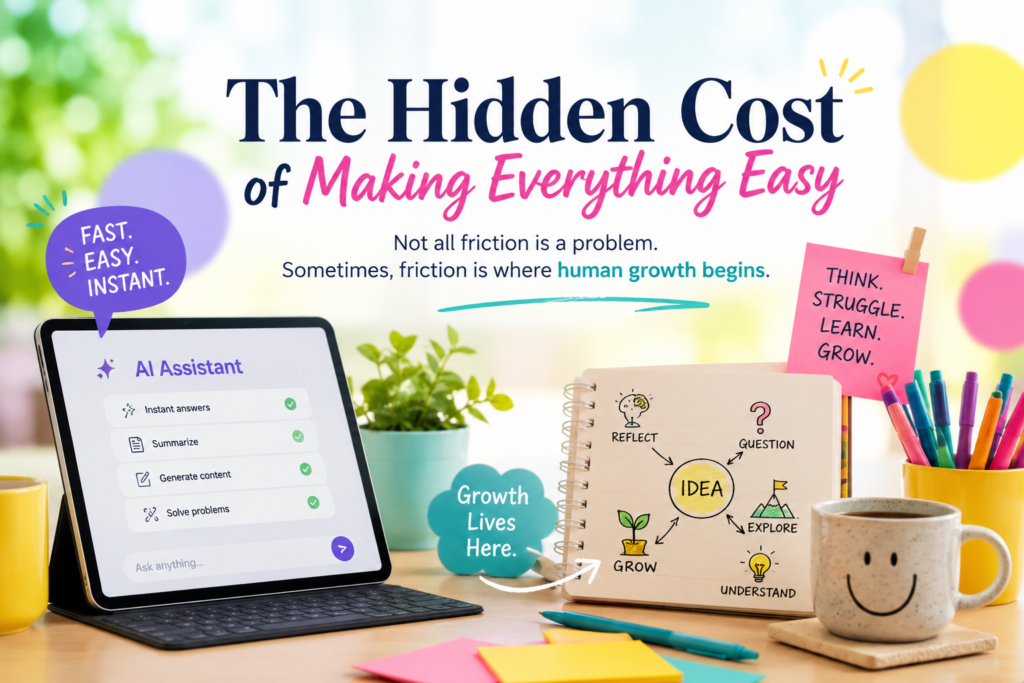
What if the problem is not that AI is becoming too intelligent but that it is making thinking increasingly optional?
Technology has always promised to make life easier. The wheel reduced the effort of carrying heavy loads. The calculator reduced the effort involved in complex calculations. GPS reduced the effort required to navigate unfamiliar roads.
Today, generative AI reduces the effort involved in writing, coding, designing, analysing and working through complex problems.
There is no doubt that these innovations improve efficiency. They save time, increase productivity and remove unnecessary burdens from our daily work.
The Difference Between Good Friction and Bad Friction
In engineering, friction is commonly understood as resistance that slows movement.
In human learning, however, friction can mean something very different. It can refer to the effort, difficulty or resistance experienced while attempting to understand, create or solve something.
Some forms of friction consume time without adding value. Other forms of friction are the very processes through which capability develops.
Bad Friction
These obstacles add delay or frustration without contributing meaningfully to learning.
- Completing repetitive administrative tasks
- Searching endlessly for a missing file
- Copying the same information between systems
- Waiting for unnecessarily complicated processes
Good Friction
These forms of effort stretch the mind and help develop deeper capability.
- Organising ideas before writing
- Working through a difficult problem
- Revising an argument after receiving feedback
- Reflecting before making a decision
The Gym Where Every Weight Feels Light
Imagine walking into a gym where every weight weighs almost nothing. Every exercise becomes easy. Every movement feels effortless.
Would your muscles become stronger?
Probably not. Muscles develop because they work against resistance. The resistance is not an unfortunate interruption to the training. The resistance is the training.
If there is no resistance, what exactly is being trained?
Human thinking develops in much the same way. Judgement develops through uncertainty. Creativity grows through exploration. Understanding deepens through revision, reflection and occasional failure.
Thinking Is Often Built Inside the Process
The visible answer is only one part of learning. Much of the real intellectual development occurs during the process that precedes it.
When a learner develops an idea, confronts confusion, makes a mistake and revises an initial response, the mind is not merely moving towards an answer. It is building the ability to reason.
When AI supplies the destination instantly, do we still travel through enough of the journey to learn?
AI Is Changing More Than the Speed of Work
Much of the public conversation about AI focuses on productivity. How quickly can we write? How much time can we save? How many tasks can we automate?
These are useful questions. They are not necessarily the most important ones.
If AI removes repetitive administrative work, that is progress. If it reduces unnecessary complexity, that is progress.
But if AI also removes the productive struggle that helps people develop understanding, independence and judgement, then convenience may quietly create a different kind of cost.
The issue is not AI itself. The issue is whether we can distinguish between effort that wastes human capacity and effort that develops it.
Learning Was Never Meant to Be Completely Frictionless
Children do not learn to walk because someone carries them forever. Researchers do not develop expertise because every answer arrives instantly. Professionals do not build wisdom simply by receiving correct solutions.
Growth requires participation. Learning requires engagement. Thinking requires effort.
This does not mean that difficulty should be created merely for the sake of making life harder. It means recognising that certain forms of effort have developmental value.
Some struggles are not barriers to learning. They are part of learning itself.
Designing AI Use That Preserves Human Growth
The future should not be built around rejecting AI. Nor should it be built around allowing AI to replace every thinking process.
A more meaningful goal is to use AI in ways that remove low-value friction while preserving the intellectual effort through which humans continue to grow.
AI can help us move more quickly through routine tasks so that more time remains for interpretation, dialogue, creativity and careful decision-making.
But that balance will not happen automatically. It must be designed.
What Might We Lose When Everything Becomes Easy?
The greatest risk of AI may not be that machines become more intelligent.
A quieter risk is that humans gradually stop exercising the abilities that make intelligence meaningful.
We may become faster at producing answers while becoming less patient with uncertainty. We may generate more ideas while spending less time developing our own. We may complete more tasks while becoming less aware of the thinking those tasks once required.
Convenience is valuable. Efficiency is valuable. Automation is valuable.
But when making everything easier also makes thinking optional, we may gain speed while quietly losing depth.
Technology should reduce unnecessary effort. It should not eliminate the experiences that help us become wiser.
Because not all friction is a problem.
Sometimes, friction is where human growth begins.